

 Français



Secure payment
3D secure

Delivery in 72 hours
Sending with tracking

Description
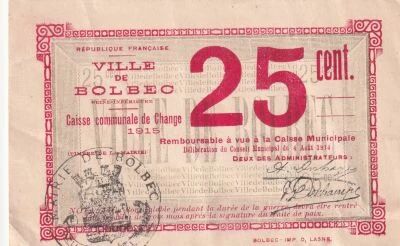
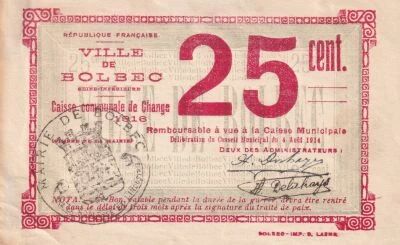
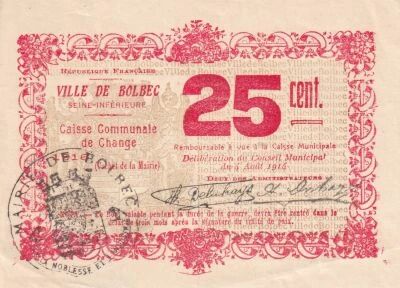
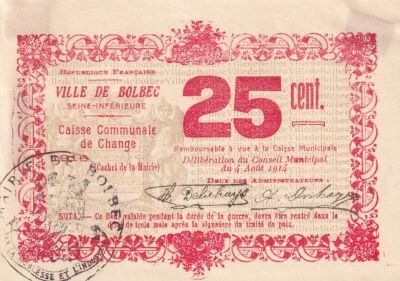
The 25 centimes note issued by the Town of Bolbec through the Caisse Communale de Change stands as a direct testimony to the monetary difficulties experienced by France during the First World War. Issued in 1916, this local emission reflects a context of widespread shortage of small change, which led many municipalities and chambers of commerce to produce their own means of payment in order to compensate for the lack of currency in circulation.
Bolbec, an industrial town located in Seine-Maritime, in Normandy, was among the French towns that resorted to these emergency issues. The Caisse Communale de Change was the local institution responsible for guaranteeing and issuing these notes, lending this paper money an administrative legitimacy at the municipal level.
This type of emergency note, also referred to as war currency or cash voucher, circulated within a limited territory and met an immediate practical need. The face value of 25 centimes represents a modest denomination, intended for everyday transactions at a time when metallic coinage was sorely lacking.
From a numismatic perspective, these municipal issues from the 1914-1918 period hold undeniable historical and documentary interest. They reflect local organisation in the face of the economic constraints of war and bear witness to the diversity of solutions adopted across French territory. Each note thus constitutes a primary document on the wartime economy at a local scale.
Its state of preservation and the graphic details characteristic of municipal printing of the era make it a representative collectible of French local issues from the First World War.