

 Français



Secure payment
3D secure

Delivery in 72 hours
Sending with tracking

Description
Remarks:
Quelques traces d'usure.
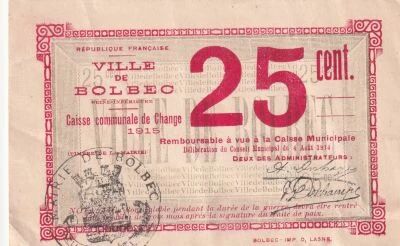
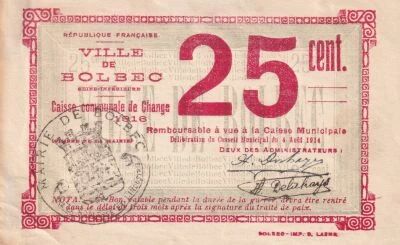
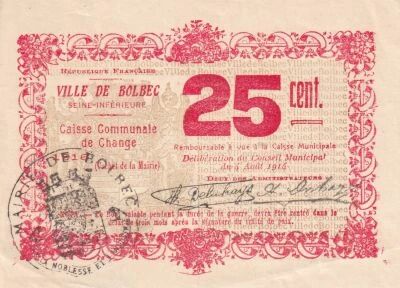
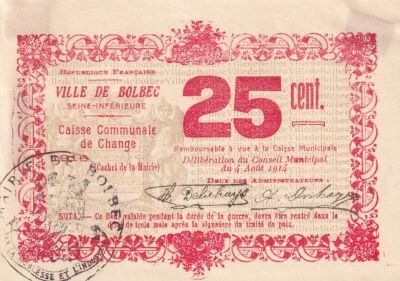
The 2-franc necessity note from the town of Bolbec, issued by the Caisse Communale de Change in 1916, represents a direct testimony to the monetary difficulties encountered during the First World War in France. Faced with a shortage of metallic currency, many French municipalities, chambers of commerce and local establishments were forced to issue their own temporary means of payment, commonly known as necessity notes.
Bolbec, an industrial town in Seine-Maritime, in Normandy, particularly well known for its textile industry, put this local fiduciary note into circulation to offset the lack of currency in circulation. The Caisse Communale de Change assumed the role of a local issuing authority, theoretically guaranteeing the value of the note to the local population and merchants of the region.
This note has a face value of 2 francs, a denomination corresponding to common use in everyday transactions of the time. This type of local issue was de facto legal tender within the geographical area concerned, even though its validity remained strictly limited to the municipal or regional territory of issue.
From the perspective of preservation and numismatic study, these necessity notes today constitute precious historical documents, illustrating the mechanisms of local economic adaptation in times of crisis. Their often limited print run and their intrinsic fragility as a paper medium explain their relative rarity in good condition. The note has a weight of 1 gram, a typical characteristic of paper issues of this format and period.
Collectors specialising in French necessity currency or in local Norman history pay particular attention to these issues, which accurately document the economic and administrative realities of French municipalities during the First World War.