

 Français


Secure payment
3D secure

Delivery in 72 hours
Sending with tracking

Description
Remarks:
Quelques traces d'usure.
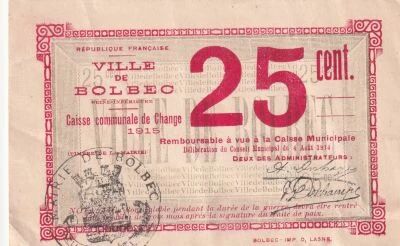
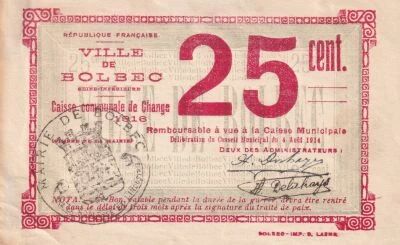
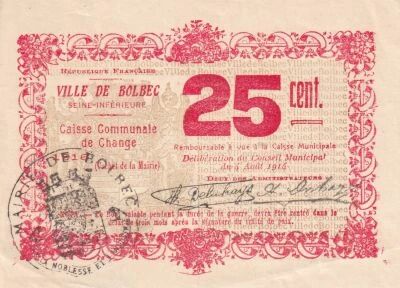
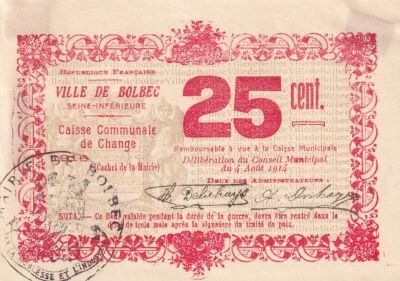
The 2-franc voucher from the City of Bolbec, issued in 1915 by the Caisse Communale de Change (Municipal Exchange Office), is a remarkable example of emergency currency produced during the First World War. This period of conflict led to a widespread shortage of metallic coinage in France, prompting numerous municipalities, chambers of commerce and private establishments to issue their own local fiduciary instruments in order to compensate for the lack of currency in circulation.
Bolbec, a municipality located in Seine-Maritime, in Normandy, was one of those localities that established a municipal fund dedicated to the issuance of these exchange vouchers. The face value of 2 francs represents an intermediate denomination, intended to facilitate everyday transactions within the local community and surrounding businesses.
This type of note, commonly referred to as emergency currency or war money, holds significant historical and numismatic interest. It bears witness to the autonomous organisation of French local authorities in the face of the economic disruptions caused by the First World War. These municipal issues were generally accepted only within a limited geographical area, corresponding to the zone of influence of the issuing entity.
As a banknote, this voucher from the Caisse Communale de Change of Bolbec illustrates the diversity of monetary solutions adopted at the local level between 1914 and 1918. The weight of 1 gram of this document reflects its paper nature, characteristic of fiduciary issues of that era. The explicit mention of the issuing town, the responsible office, the year of issue and the value ensured a clear identification of the payment instrument for its users, while today serving as a direct testimony to local economic adaptations in times of crisis.