

 Français



Secure payment
3D secure

Delivery in 72 hours
Sending with tracking

Description
Remarks:
Quelques traces d'usure.
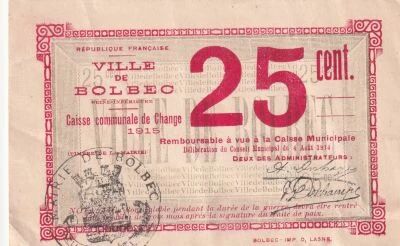
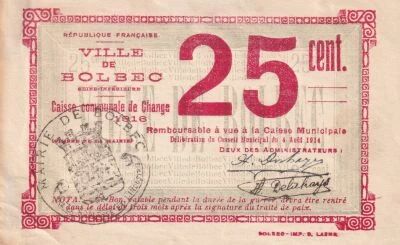
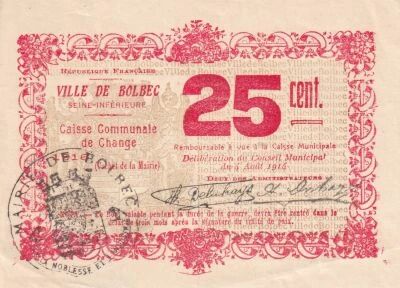
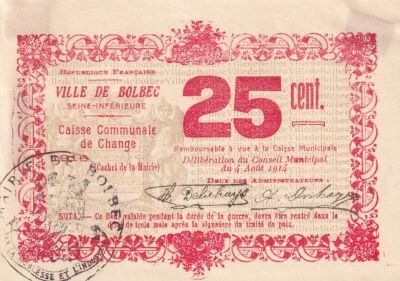
The 1 Franc Note from the Caisse Communale de Change of the City of Bolbec is an emergency banknote issued in 1917 in the department of Seine-Inférieure, today known as Seine-Maritime. This type of local fiduciary paper currency is directly linked to the context of the First World War, a period during which the shortage of metallic coinage forced many French municipalities to issue their own means of payment.
Bolbec, an industrial town in the Normandy region, was among the many municipalities that resorted to this pragmatic solution in order to compensate for the lack of circulating currency. The Caisse Communale de Change was the municipal body responsible for issuing and guaranteeing these notes, which were legal tender within the municipal territory and its immediate surroundings.
This note has a face value of one franc, the French monetary unit in use at the time. These local issues, often referred to as "emergency money" or "necessity notes", were produced on paper and represented a direct response to the economic disruptions caused by the global conflict. Their period of circulation was generally limited to the crisis period, after which they were withdrawn and replaced by the official national currency.
Emergency banknotes issued during the Great War now represent a particularly well-documented category in the field of notaphily, the collecting of banknotes and paper money. They bear witness to local economic adaptations in the face of the constraints of a large-scale conflict. The Bolbec note is part of this broader collection of French municipal issues from 1914 to 1922, a period covering all emergency issues across the national territory.