

 Français



Secure payment
3D secure

Delivery in 72 hours
Sending with tracking

Description
Remarks:
Quelques traces d'usure.
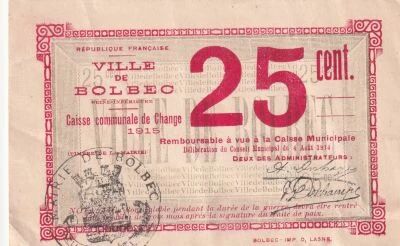
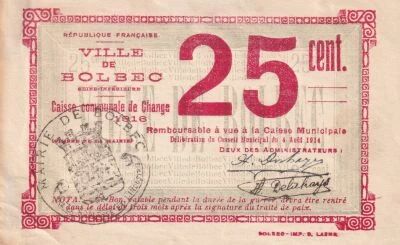
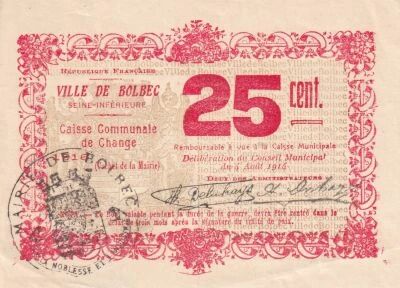
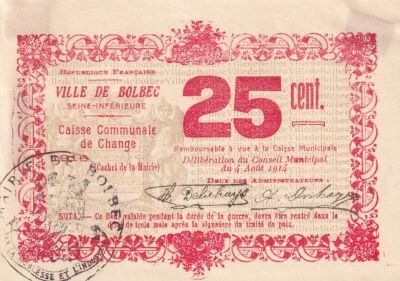
The 1 franc note issued by the Caisse Communale de Change de la Ville de Bolbec, in Seine-Inférieure (now Seine-Maritime), is a representative example of emergency currency produced in France during World War I. Issued in 1917, this note was born out of a widespread monetary shortage, during which many municipalities and chambers of commerce were forced to issue their own fiduciary instruments to compensate for the lack of small change in circulation.
Bolbec, an industrial and commercial town in the Normandy region, established its own Caisse Communale de Change, a local authority empowered to issue these notes intended to facilitate economic exchanges within the community. This type of local banknote was only valid within the territory of the issuing municipality and constituted a payment commitment at face value guaranteed by the municipality.
This note has a face value of 1 franc, the reference monetary unit in France at the time. It belongs to the large family of emergency banknotes, also known as war currencies or circumstantial issues, whose production saw considerable growth between 1914 and 1920 across the entire French territory.
These municipal issues are today of great interest to collectors and historians, as they bear witness to the local economic mechanisms put in place during times of crisis. The town of Bolbec, the chief town of a canton in Seine-Inférieure, is among the many Norman localities that resorted to this system, which gives this note a notable documentary and historical value for understanding the local economy of France in 1917.