

 Français



Secure payment
3D secure

Delivery in 72 hours
Sending with tracking

Description
Remarks:
Quelques traces d'usure, épinglage.
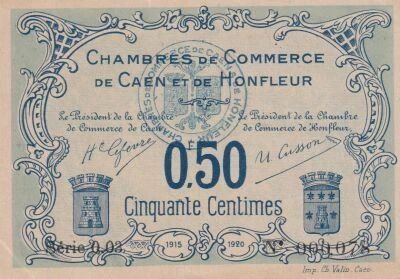
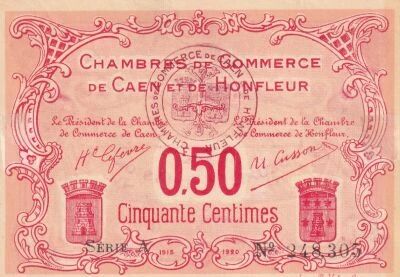
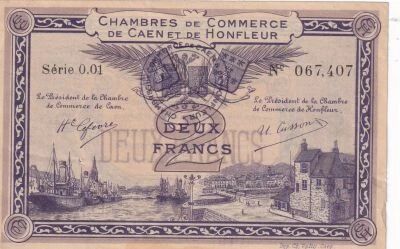
This banknote with a face value of 1 franc was issued by the Chamber of Commerce of Caen and Honfleur between 1915 and 1920, in the particular context of the First World War. During this period, the shortage of metallic currency forced many French chambers of commerce to issue their own emergency notes, in order to compensate for the lack of currency in circulation.
This note belongs to series 0.02, a classification reference that allows precise identification of its issue within the various emissions produced by this chamber of commerce. These emergency notes, issued at the local level, are today important historical witnesses of the regional economic organisation during the war period and the immediate post-war years.
The note is linked to the territory of Calvados, the department of which Caen is the county town, and also covers the port town of Honfleur, two significant economic centres of the Normandy region. The Chamber of Commerce of Caen and Honfleur was then authorised to issue these notes intended to facilitate local commercial exchanges as a substitute for metallic coins that had become scarce.
The weight of this note is 1 gram, which corresponds to the usual characteristics of emergency notes of that era, printed on thin paper. These local issues generally feature clear identification details such as the name of the issuing body, the face value, as well as various indications relating to their legal validity and conditions of reimbursement.
Chamber of commerce notes of this generation are today highly sought-after collectibles among numismatists specialising in French emergency currency from the early 20th century, owing to their historical character and strong territorial roots.