

 Français



Secure payment
3D secure

Delivery in 72 hours
Sending with tracking

Description
Remarks:
Quelques traces d'usure.
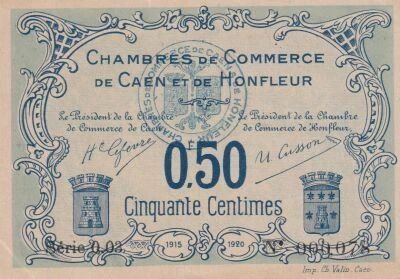
This 50-centime necessity note was jointly issued by the Chambers of Commerce of Caen and Honfleur, two major economic institutions in the department of Calvados. It was issued in the context of World War I, a period during which the shortage of metallic currency forced many French chambers of commerce to issue local fiduciary banknotes to compensate for the lack of currency in circulation.
This note belongs to the second issue of the series, classified under Series A, and bears the issue date of 1920, although the validity period of this issue extends from 1915 to 1920. This time frame reflects the prolonged duration of the monetary crisis that affected France well beyond the armistice of 1918.
The face value of this note is 50 centimes, making it a commonly used denomination intended to facilitate everyday transactions at the local level. These regional issues are of particular historical and numismatic interest, as they reflect the territorial economic organisation of France during this troubled period.
From a physical standpoint, this note has a weight of 1 gram, characteristic of the fiduciary paper of the time. Necessity notes issued by the Norman chambers of commerce during this period are now precious witnesses to local monetary history, and their state of preservation is a determining factor in their evaluation. The joint oversight of the chambers of Caen and Honfleur over this issue is representative of the institutional collaborations established to meet the economic demands of the period, with the two port and commercial cities of Normandy uniting their authorities to guarantee the credibility and acceptance of this paper currency at the regional level.