

 Français
 Espagnol
 Allemand
 Italien







Secure payment
3D secure

Delivery in 72 hours
Sending with tracking

Description
Remarks:
Plis, épinglages, salissures
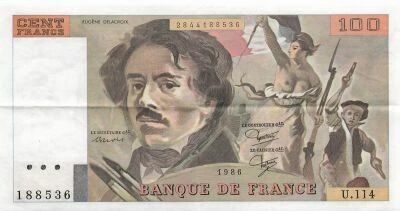
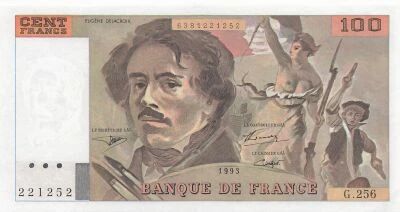
This banknote is a 100 Francs, issued in France. The denomination was put into circulation in 1979. The banknote belongs to the X.17 series.
The banknote represents a nominal value of 100 francs, the monetary unit of France at that time.
The banknote is commonly called "Delacroix", after the main character depicted on the front. Eugène Delacroix, born in 1798 and died in 1863, was an emblematic painter of the French Romantic movement. His most famous work is probably "Liberty Leading the People".
The iconography of the banknote includes a portrait of Eugène Delacroix, often accompanied by elements referring to his pictorial work. These visual elements may include color palettes, brushes, or miniature reproductions of his most famous paintings. The aim is to pay tribute to his artistic legacy and his contribution to French culture.
The presence of watermarks and complex security patterns is integrated into the design of the banknote. These elements are intended to prevent counterfeiting and ensure the authenticity of the banknote. The watermarks are visible through transparency when the banknote is exposed to a light source.
The typography used to indicate the nominal value and legal notices is neat. The colors used on the banknote are chosen for their aesthetics and for their ability to make counterfeiting more difficult. The combination of bright colors and subtle nuances contributes to the overall appearance of the banknote.