

 Français
 Espagnol
 Allemand
 Italien





Secure payment
3D secure

Delivery in 72 hours
Sending with tracking

Description
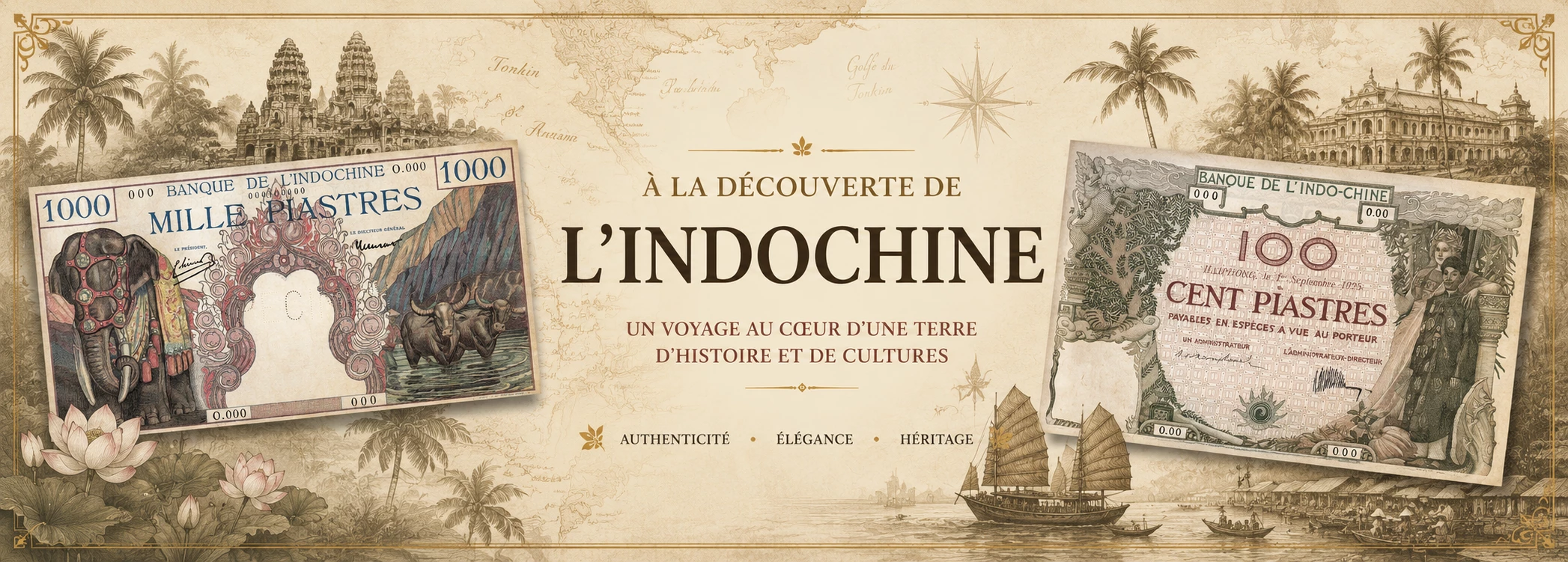
This banknote is a 100 piastre specimen, issued by the Banque de l'Indochine in Saigon in 1903. It falls under the decrees of January 21, 1875, February 20, 1888, and May 16, 1900, which governed the issuance of currency in French Indochina.
The front of the note features several distinct graphic elements. On the left, there is a portrait of Vasco de Gama, a historical figure associated with maritime exploration. At the bottom, in the center of the note, a representation of sailboats evokes the maritime and commercial context of Indochina at that time. On the right, a Polynesian man holding a paddle stands near a dragon, a mythological creature often associated with Asia.
The inscriptions on the banknote provide essential information. The mention "Banque de l'Indochine" indicates the issuing institution. The face value, "Cent Piastres", is repeated several times. The mention "Payable en espèces au porteur" guarantees the convertibility of the note into metallic currency. The names A. Bramtot and G. Duval Fec. as well as J. Robert Sc. refer to the artists who contributed to the design and engraving of the note.
Alfred-Henri Bramtot and Georges Duval are credited as designers, while Charles-Jules Robert is identified as the engraver. Their combined skills produced a banknote that reflects the cultural and economic influences of French Indochina in the early 20th century.