

 Français
 Espagnol
 Allemand
 Italien





Secure payment
3D secure

Delivery in 72 hours
Sending with tracking

Description
Remarks:
Salissures sur la marge du billet
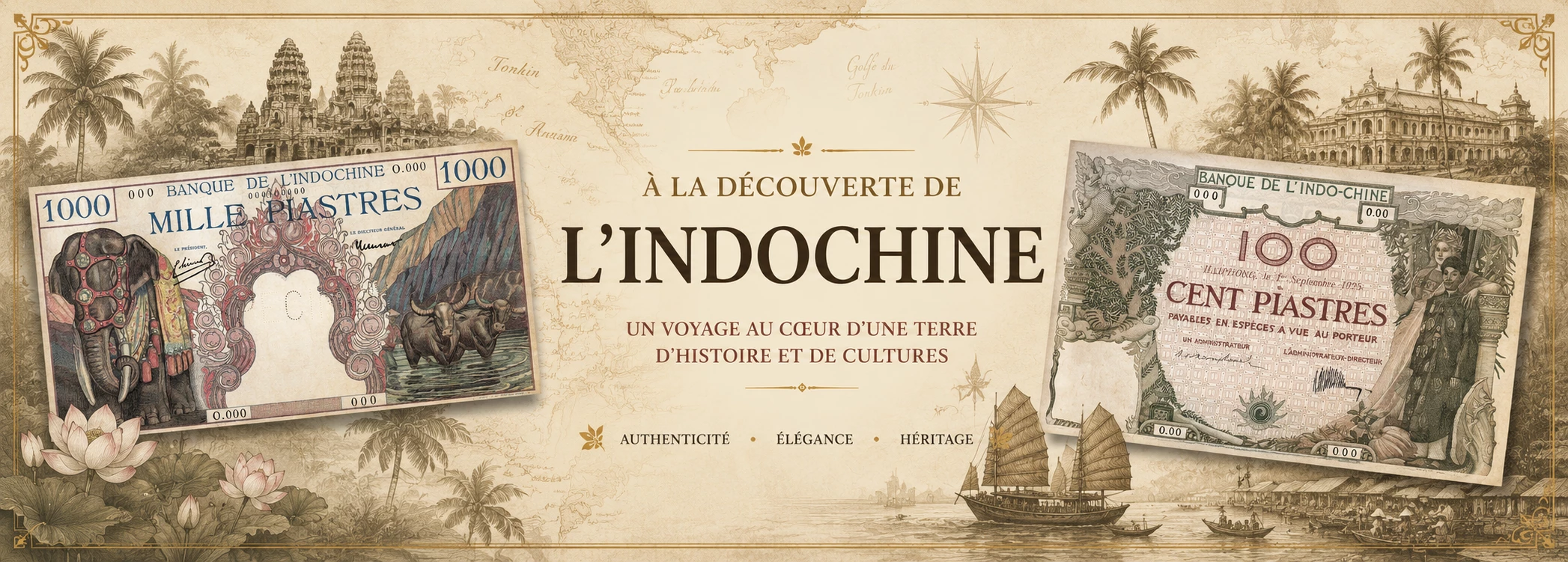
This 1000 piastres banknote is a specimen issued in 1951 for French Indochina, a territory comprising Vietnam, Cambodia and Laos at the time, all under French colonial administration. It is a specimen type example, meaning a banknote produced for reference or presentation purposes, and not intended for general circulation. Such specimens were typically distributed to banking institutions and monetary authorities to enable them to identify authentic banknotes in circulation.
The face value of 1000 piastres makes it one of the highest denominations issued for this region. The Indochinese piastre was the official currency of French Indochina, managed by the Banque de l'Indochine, a private institution holding the privilege of monetary issuance in the relevant territories.
The iconography of this banknote centres on the depiction of an elephant, an emblematic animal of South-East Asia, deeply rooted in the cultures and traditions of the Indochinese peoples. It held significant symbolic importance in both civil use and the royal and administrative representations of the region. This iconographic choice reflects a desire to ground monetary instruments within a local cultural context.
The year 1951 corresponds to a particularly tense historical period for French Indochina, marked by the First Indochina War. This period directly influenced the monetary organisation of the region, progressively leading to the creation of distinct national currencies for each of the associated states. This banknote thus represents one of the last high-value issues under French monetary authority in the region, lending it a notable historical and documentary significance for collectors and historians of colonial numismatics.