Français
 Espagnol
 Allemand
 Italien


 Français
 Espagnol
 Allemand
 Italien








Secure payment
3D secure

Delivery in 72 hours
Sending with tracking

Description
Remarks:
Plis de comptage
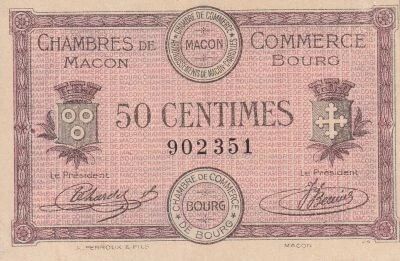
This 50 centimes banknote was issued by the town of Louviers on 27 February 1916, as part of a French municipal issue dating from the First World War. At that time, the shortage of metallic currency, caused by hoarding and the growing demands of the war effort, forced many French municipalities and chambers of commerce to circulate their own emergency banknotes in order to compensate for the lack of currency in circulation.
Louviers, a Norman town located in the Eure department, was one of the many local authorities that resorted to this temporary solution to maintain commercial exchanges within their territory. These local issues, although only legal tender within the issuing municipality, played an essential role in the daily economic life of the civilian population during the conflict.
The banknote has a face value of 50 centimes and bears the precise mention of its issue date, namely 27 February 1916, which constitutes an important identification element for collectors and historians. This type of emergency paper money is today considered a direct witness to the economic disruptions caused by the Great War on French territory.
Municipal banknotes from this period are now highly sought-after collectibles, both for their historical and documentary value and for the graphic and typographic diversity they display depending on the issuing municipality.