

 Français




Secure payment
3D secure

Delivery in 72 hours
Sending with tracking

Description
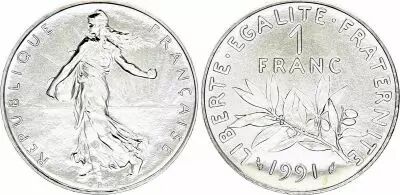
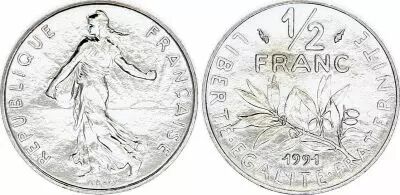
The 1 franc Semeuse in nickel dated 1969 is a coin issued by the Monnaie de Paris, recognisable by the mint mark A, corresponding to the Parisian workshop. This coin is part of the nickel Semeuse franc series, introduced in France from the 1960s onwards, replacing the former aluminium-bronze series.
The obverse of this coin features the famous Semeuse motif, an emblematic figure in French numismatics originally created by the engraver Oscar Roty at the end of the 19th century. It depicts a woman in profile, walking to the left, sowing seeds against the wind, with a rising sun in the background. This representation symbolises the French Republic and fertility. The face value 1 franc and the minting year 1969 are inscribed on it, accompanied by the name FRANCE.
The reverse features the face value framed by two wheat ears and two branches, a sober and balanced composition that characterises the entire series.
The coin is struck in pure nickel, a metal that gives this coin its characteristic greyish hue and good resistance to wear. It weighs 6 grams and has a diameter of 24 millimetres, dimensions that make it a medium-sized coin, comfortable to hold.
The year 1969 corresponds to a particularly significant production year, with a mintage reaching 70,601,050 examples. This high mintage volume reflects the significant needs for fiduciary circulation in France at that time. Despite this considerable mintage, examples preserved in near-mint condition remain sought after by collectors of 20th-century French coins.