

 Français




Secure payment
3D secure

Delivery in 72 hours
Sending with tracking

Description
The medal presented is an allegory of Marianne, embodying the French Republic. It is struck in bronze and dates approximately from 1880. The attribution of the engraver or foundry remains currently unknown.
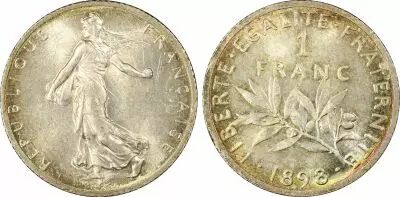
The obverse of the medal depicts Marianne, wearing a Phrygian cap adorned with a cockade. Her wavy hair frames her face with its fine and determined features. Her gaze is directed to the right, suggesting a promising future. The legend "République Française" is engraved in an arc above her head, in regular capital letters.
The reverse of the medal lacks any central motif. A smooth, uniform surface offers a neutral space, allowing attention to be focused on the obverse and the figure of Marianne. The absence of details on the reverse may indicate mass production or a desire to simplify the design. It is possible that an inscription or symbol was planned for this location, but was never realized.
The edge of the medal is smooth and has no particular markings. The bronze, the manufacturing material, gives the medal a warm color and a natural patina due to its age. Traces of wear and handling are visible, testifying to its history and its journey through time. The diameter of the medal is standard for this type of commemorative object from the late 19th century.
The lack of precise attribution makes this medal particularly interesting for collectors and researchers. It invites further investigation to identify its creator and its exact production context.