Français
 Espagnol
 Allemand
 Italien


 Français
 Espagnol
 Allemand
 Italien






Secure payment
3D secure

Delivery in 72 hours
Sending with tracking

Description
This 50 centime banknote was issued by the Dunkirk Chamber of Commerce in 1918. It is an emergency issue, often put in place during times of economic crisis or currency shortage.
The obverse of the banknote features the nominal value "50c" repeated in all four corners. In the center, there is the mention "CHAMBRE DE COMMERCE / DE DUNKERQUE" followed by the value "50 CENTIMES". The signatures of the Treasurer and the President of the Chamber of Commerce, as well as the mention "L. LECLERC. IMP. CHAIX.", complete the composition. The designer of this banknote is Léon Leclerc.
The reverse of the banknote displays the mention "CHAMBRE DE COMMERCE" at the top, framing the value "50" repeated twice. Below, it reads "CENTIMES CENTIMES" and "DUNKERQUE".
The banknote incorporates a watermark representing leaves, adding an element of security and authenticity. The printing was done by Imprimerie Chaix, a Parisian establishment active from 1845 to 1965. This detail allows us to place the production of the banknote in a precise historical and industrial context.
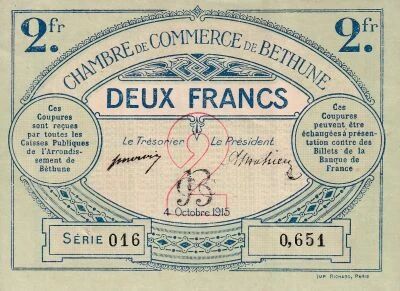
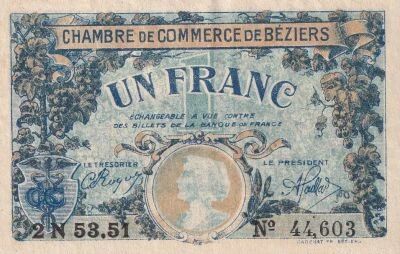
This type of banknote demonstrates the alternative monetary practices implemented by local institutions to overcome the difficulties of supplying currency during the First World War.