Français
 Espagnol
 Allemand
 Italien


 Français
 Espagnol
 Allemand
 Italien






Secure payment
3D secure

Delivery in 72 hours
Sending with tracking

Description
Remarks:
Plis, 1 épinglage
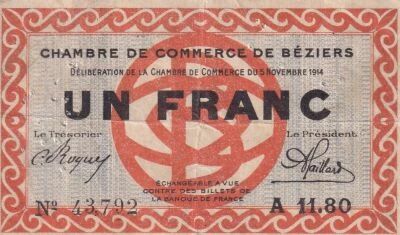
The 50-centime banknote issued by the Bergerac Chamber of Commerce, dated October 5, 1914, represents a form of emergency money issued in France during World War I. These local issues were common to compensate for the lack of official currency in circulation.
This banknote belongs to Series R, indicating a specific classification within the issues of the Bergerac Chamber of Commerce. The face value is clearly indicated at 50 centimes, a small fraction of a franc intended for low-value, everyday transactions.
The absence of information on the associated personality and issuing institution, beyond the Bergerac Chamber of Commerce, suggests that the issue was centered on the local institution itself, without reference to national figures or central banks. The year of issue, 1914, is crucial, as it coincides with the beginning of World War I, a period during which many Chambers of Commerce issued currency to facilitate local commerce in times of crisis.
The banknote's design likely reflects the constraints of the time, with simple graphics and rudimentary printing. Legal notices and the signatures of the Chamber of Commerce officials would have appeared on the banknote to guarantee its authenticity and value. The color and type of paper used were typical of the materials available locally at that time.
These emergency banknotes are valuable testimonies to the economic and social history of France during World War I. They illustrate the local adaptations to financial difficulties and how local institutions helped maintain economic activity in the absence of sufficient national currency.