Français
 Espagnol
 Allemand
 Italien


 Français
 Espagnol
 Allemand
 Italien






Secure payment
3D secure

Delivery in 72 hours
Sending with tracking

Description
Remarks:
Plis
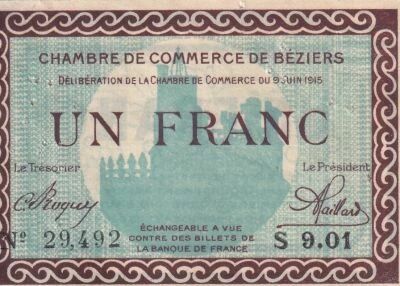
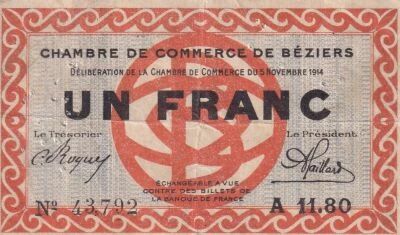
The 50 centime note issued by the Belfort Chamber of Commerce, dated October 12, 1921, represents a form of emergency currency produced in France during a period of economic constraints. This type of note was put into circulation to alleviate the lack of liquidity and facilitate local transactions.
This 50 centime note belongs to Series A. The absence of additional information on the issuing institution suggests that the Belfort Chamber of Commerce had specific autonomy in issuing this local currency.
The note is dated 12-10-1921. The face value is clearly indicated as 50 centimes, a fraction of a franc intended for small everyday transactions.
In terms of appearance, the note is printed on simple paper, typical of emergency issues. The colors used are limited, often one or two colors for economic and printing simplicity reasons. The graphics are generally simple, with geometric patterns, local coats of arms, or allegorical representations of commerce and industry. The typography is clear, indicating the face value and the issuer.
The dimensions of the note are modest, facilitating its handling and storage. The state of preservation of these notes varies considerably depending on their circulation and storage over time. Folds, stains, and tears are frequent, but specimens in good condition are more sought after by collectors.