Français
 Espagnol
 Allemand
 Italien


 Français
 Espagnol
 Allemand
 Italien






Secure payment
3D secure

Delivery in 72 hours
Sending with tracking

Description
This 50 centime banknote was issued by the Chamber of Commerce of Quimper and Brest in 1915, Series A. It is an emergency issue, dating from the First World War. This type of banknote was put into circulation due to the shortage of metallic currency during this period.
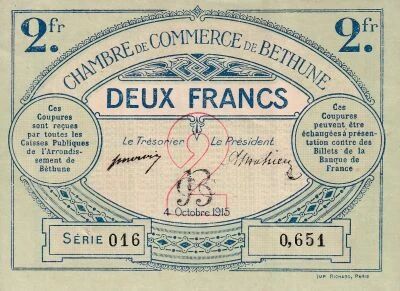
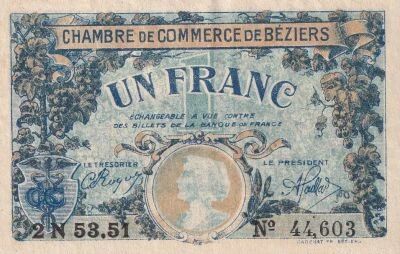
The banknote features a simple design, printed on light-colored paper. The face value, "50 Centimes", is clearly indicated in numbers and letters. The mention "Chamber of Commerce of Quimper and Brest" also appears, highlighting the issuing body. The date of issue, "1915", is printed on the banknote. The serial number, here "229732", is unique to each banknote and is used for identification and control of circulation.
The banknote is predominantly blue and ochre in color, with simple typographical and decorative motifs. The text is in French. The dimensions are small, which is common for low-value banknotes of that time.
This banknote represents a historical testimony of the First World War period, where the Chambers of Commerce played a crucial role in managing local finances in the absence of sufficient fiduciary currency. Its numismatic value lies in its state of conservation and its rarity, as well as in its historical importance as an alternative means of payment during a period of economic crisis.