Français
 Espagnol
 Allemand
 Italien


 Français
 Espagnol
 Allemand
 Italien








Secure payment
3D secure

Delivery in 72 hours
Sending with tracking

Description
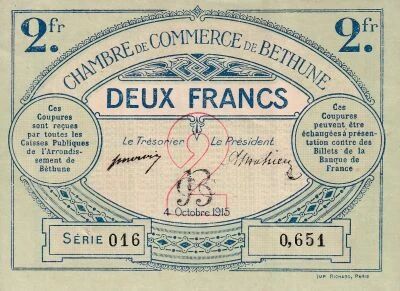
This 5-franc emergency banknote was issued on April 20, 1916, by the cities of Roubaix and Tourcoing, located in the Nord department (59). It belongs to the 7th series, referenced R9004.
This type of banknote was produced in the context of the Common and City Necessities during the period 1914-1918, an era marked by economic and social disruptions related to World War I. The issuance of these banknotes aimed to compensate for the lack of fiduciary currency in circulation.
The banknote bears the signatures of officials whose names are not specified in the provided data. The issuance of this banknote was approved by the prefectural authority on April 22 and 25, 1916, indicating administrative control of the issuance of this local currency.
A particularity of this banknote is that it has been canceled by perforation, a common practice to signal that it has been withdrawn from circulation and no longer has legal value. Cancellation by perforation prevented its fraudulent reuse.
This 5-franc banknote testifies to a specific historical period and the local economic difficulties encountered during World War I. It represents an example of a local response to a national monetary crisis, where cities and towns had to issue their own currency to facilitate trade and ensure the continuity of economic activity.