Français
 Espagnol
 Allemand
 Italien


 Français
 Espagnol
 Allemand
 Italien








Secure payment
3D secure

Delivery in 72 hours
Sending with tracking

Description
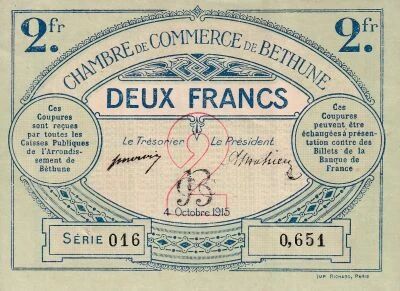
This emergency banknote, with a face value of 20 francs, was issued in France on March 27, 1917. It belongs to the 10th series of emergency issues. This type of banknote was produced in the context of economic and monetary difficulties encountered during the First World War.
The banknote is specific to the cities of Roubaix and Tourcoing, located in the Nord department. The issuance of this banknote was approved by the prefectural authority on April 10, 1917, indicating that it was issued with the agreement of the competent local authorities. This approval was necessary to guarantee the validity and acceptance of the banknote in the region.
As an emergency banknote, it was issued by local authorities in response to a shortage of fiduciary currency during the war. These banknotes were intended to facilitate local economic transactions by filling the lack of official currency in circulation. They were often issued by cities, chambers of commerce, or other local institutions.
The banknote bears traces of cancellation by perforation, suggesting that it was withdrawn from circulation after being used. Perforations were a common method to prevent the reuse of canceled banknotes.
This banknote falls within the period of Common and City Emergency Issues from 1914 to 1918, a period marked by economic and financial disruptions due to the war. These local issues demonstrate the efforts made to maintain economic activity at the local level in the face of national challenges.