Français
 Espagnol
 Allemand
 Italien


 Français
 Espagnol
 Allemand
 Italien







Secure payment
3D secure

Delivery in 72 hours
Sending with tracking

Description
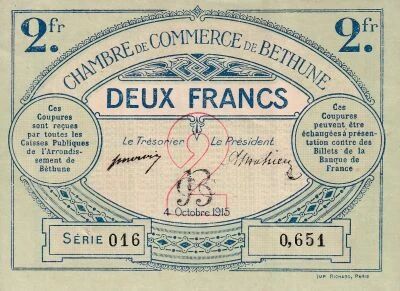
This French banknote was issued by the Chamber of Commerce of Boulogne-sur-Mer. Its face value is two francs. The banknote was issued following a deliberation of the Chamber of Commerce dated August 14, 1914, supplemented by another deliberation of July 7, 1916.
The main inscription on the front of the banknote clearly indicates the issuing institution: CHAMBRE DE COMMERCE DE BOULOGNE-SUR-MER. This inscription is followed by the mention of the deliberation authorizing the issuance of the banknote: Délibération de la Chambre du 14 Août 1914 et du 7 Juillet 1916. The face value, DEUX FRANCS, is also highlighted on the front.
The front of the banknote bears the signatures of the Treasurer and the President of the Chamber of Commerce, thus authenticating the issuance. A unique serial number is printed twice on the banknote, in this case 043043 A1 043043, serving for the individual identification of each banknote issued.
The two-franc banknote from the Chamber of Commerce of Boulogne-sur-Mer testifies to a specific period in French local economic history, marked by exceptional measures taken due to the circumstances of the time. The issuance of such banknotes by chambers of commerce was a response to the need for liquidity and facilitation of economic exchanges during this period.