Français
 Espagnol
 Allemand
 Italien


 Français
 Espagnol
 Allemand
 Italien






Secure payment
3D secure

Delivery in 72 hours
Sending with tracking

Description
Remarks:
Plis, salissures.
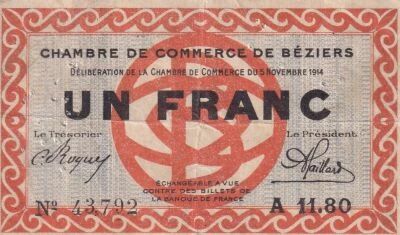
The 2-franc emergency banknote issued in Valenciennes in November 1915 (series 4) belongs to the first local monetary issues implemented during the First World War. In the occupied northern regions, the rapid shortage of metallic currency and the difficulties in supplying official banknotes made the creation of alternative payment methods essential.
Valenciennes, heavily affected by the German occupation from the beginning of the conflict, put these notes into circulation to maintain economic exchanges and ensure the continuity of daily life. This issue is part of the ?loan guaranteed by the consortium of communes of the Valenciennes region and surrounding regions?, a collective mechanism intended to guarantee the value and acceptance of these banknotes.
This consortium brought together several communes that pooled their financial guarantees, allowing for wider circulation of the notes throughout the region. These issues fulfilled several essential functions:
ensuring low-value transactions
supporting local populations
financing contributions imposed by the occupier
avoiding economic sanctions
The obverse of the note features a simple typographic composition including:
the mention of the consortium and Valenciennes
the face value of 2 francs
the date of issue (November 1915)
guarantee and post-war reimbursement notices
The reverse is generally sober, with simple decorative borders or additional mentions.
From a technical point of view, these notes were printed on paper using relatively simple processes. Nevertheless, they included basic security features, such as serial numbers and signatures, intended to limit counterfeiting.
The series 4 corresponds to a specific variant within this issue. As an early series, it may be of particular interest to collectors, especially in a good state of preservation.
These notes circulated locally and regionally, sometimes beyond depending on the agreements between the consortium's communes. After the war, they were theoretically redeemable, although the terms varied depending on economic circumstances.
From a numismatic point of view, the 2 francs Valenciennes 1915 ? series 4 is an interesting piece:
for its early nature
for its context in an occupied zone
for its role in daily exchanges
Finally, for the collector, this note constitutes a strong testament to the beginning of the war economy in an occupied region. It illustrates the rapid implementation of local monetary solutions in the face of a major crisis, making these issues objects of high historical value.