Français
 Espagnol
 Allemand
 Italien


 Français
 Espagnol
 Allemand
 Italien










Secure payment
3D secure

Delivery in 72 hours
Sending with tracking

Description
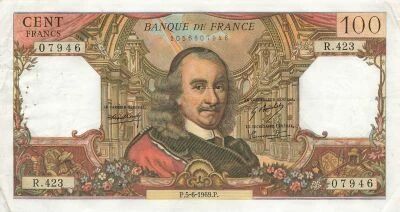
This French banknote has a face value of 100 francs. It was issued on January 2, 1953, and belongs to the E.510 series.
The front of the note features a rural scene. In the foreground, a peasant is depicted with a scythe on his shoulder, symbolizing the work of the land. In the background, a typical village can be seen with its church and traditional houses, evoking French rural life. The composition highlights the importance of agriculture and the village community.
The back of the note takes up the rural theme, but in a different atmosphere. It shows a young peasant woman sitting in a field, holding a sheaf of wheat. The image symbolizes the harvest and the fertility of the land. The landscape is hilly, with trees and cultivated fields, reinforcing the idea of an agricultural and prosperous France. The colors used are soft and natural, creating a peaceful and harmonious atmosphere.
This 100-franc banknote, commonly called "Paysan" (Peasant), is a testament to the economic and social history of France. It reflects a time when agriculture occupied a central place in the life of the country. The motifs and symbols used on the banknote highlight the values of work, land, and the rural community.