

 Français







Secure payment
3D secure

Delivery in 72 hours
Sending with tracking

Description
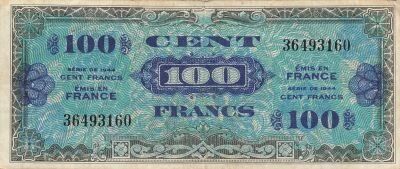
This French banknote has a nominal value of 100 francs. It was issued on May 15, 1942.
The front of the banknote depicts René Descartes, a French philosopher, scientist, and mathematician. His portrait is positioned on the right side of the note. On the left, there is an allegorical scene representing philosophy and science, with classical architectural elements and symbols of knowledge.
On the back, the banknote features a view of the city of Tours, with a representation of the Loire River and its bridges. The city's architecture is highlighted, reflecting French cultural heritage.
The banknote bears the inscription "BANQUE DE FRANCE" at the top of the front. The face value, "100 FRANCS", is indicated in words and numbers in several places on both sides. The date of issue, "15-05-1942", also appears on the front.
This banknote is part of the A.14 series. It is important to note that the serial numbers vary from one banknote to another.
The dominant colors of the banknote are blue and green, with sepia tones for the portraits and illustrations. These colors contribute to the overall aesthetics of the banknote and its visual recognition.
The format of the banknote is rectangular, with dimensions specific to banknotes of that era. These dimensions may vary slightly depending on the cut and wear of the banknote.