Français
 Espagnol
 Allemand
 Italien


 Français
 Espagnol
 Allemand
 Italien







Secure payment
3D secure

Delivery in 72 hours
Sending with tracking

Description
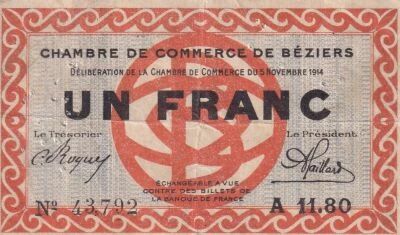
The 1 franc banknote issued in 1915 by the Chamber of Commerce of Annecy (series 102), with the word ?annulé? (cancelled), belongs to the emergency fiduciary issues implemented during the First World War. Faced with a shortage of metallic currency and economic disruptions, Chambers of Commerce were authorized to produce local banknotes intended to maintain trade.
Annecy, although located outside the occupied zone, participated in this effort by putting these banknotes into circulation to support the local economy. These issues reflect the decentralized monetary organization adopted in France during the conflict.
The obverse features a clear typographic composition including:
the mention ?Chambre de Commerce d?Annecy?
the face value of 1 franc
the year 1915
the serial numbering (102)
signatures and guarantee mentions
The reverse is generally sober, with simple decorative frames or additional mentions related to the terms of issue.
From a technical point of view, these banknotes are printed on fiduciary paper using relatively simple processes. Nevertheless, they include basic security features: numbering, signatures, and sometimes administrative stamps or markings.
The mention ?annulé? indicates that the banknote was:
withdrawn from circulation after use
administratively invalidated upon reimbursement
kept as accounting proof
These banknotes often show visible traces of cancellation: perforations, stamps, surcharges, or handwritten annotations.
These issues circulated locally, mainly in the Annecy region, before being gradually withdrawn after the war when the monetary situation normalized.
From a numismatic point of view, the 1 franc Annecy 1915 ? series 102 ? cancelled is an interesting piece:
for its historical context
for its particular status (cancelled)
for its administrative dimension
Although generally less sought after than a non-cancelled specimen, this type of banknote offers specific interest, particularly for the study of reimbursement circuits and the management of local currencies.
Finally, for the collector, this banknote constitutes a complete testament to the life cycle of emergency currency, from its issuance to its withdrawal, adding an extra historical dimension to the object.