Français
 Espagnol
 Allemand
 Italien


 Français
 Espagnol
 Allemand
 Italien






Secure payment
3D secure

Delivery in 72 hours
Sending with tracking

Description
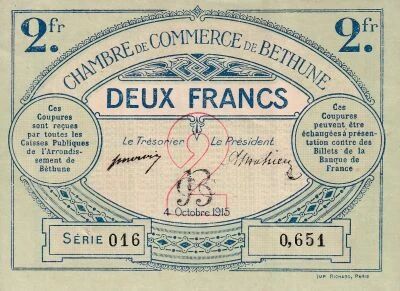
The 1 Franc banknote issued by the Chamber of Commerce of Quimper and Brest in 1915 represents an emergency means of payment put into circulation in France during the First World War. This type of banknote testifies to the economic difficulties and the need to compensate for the lack of metallic currency during this period.
This banknote, dated 1915, bears the mention of the Chamber of Commerce of Quimper and Brest, indicating the local issuing authority. Its face value is clearly indicated as 1 Franc, the French monetary unit of the time. The serial number, here A.799779, is printed on the banknote, serving for its identification and monitoring by the issuing body.
The visual design of the banknote is typical of emergency issues, with simple motifs and clear inscriptions. It is likely that the graphics include distinctive elements of the Quimper and Brest region, although the specific details would require a direct visual examination. The year of issue, 1915, is prominent, highlighting the historical context of its production. These banknotes were often printed on paper of varying quality, reflecting the material constraints of the time.
The state of preservation of this banknote is a determining factor in its numismatic value. Banknotes in good condition, with few creases, tears or discoloration, are generally more popular with collectors. The rarity of this specific banknote, depending on its series and condition, also contributes to its interest for collectors of French emergency banknotes.