Français
 Espagnol
 Allemand
 Italien


 Français
 Espagnol
 Allemand
 Italien






Secure payment
3D secure

Delivery in 72 hours
Sending with tracking

Description
Remarks:
Plis, coin manquant
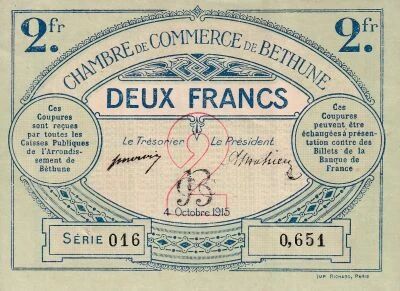
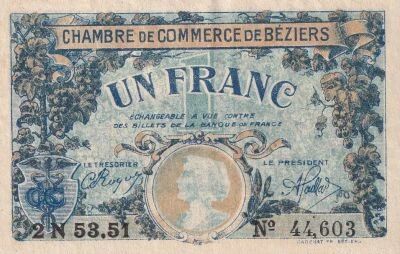
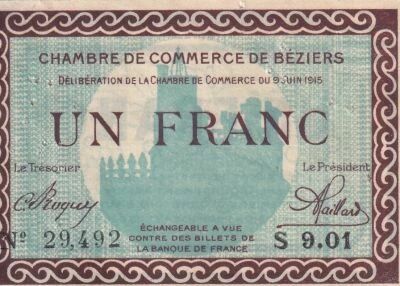
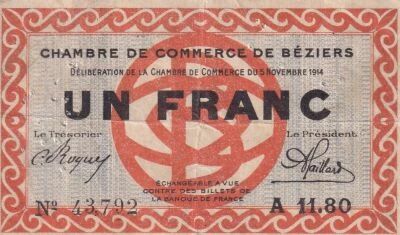
The one-franc banknote issued by the Belfort Chamber of Commerce, dated August 18, 1915, is an example of emergency issues produced in France during the First World War. These local issues were intended to compensate for the shortage of fractional currency caused by the mobilization of precious metals for the war effort and by the hoarding of money by the population.
This banknote is characterized by its simplicity of design, reflecting the production constraints of the time. It is printed on modest quality paper, with generally monochrome ink, often black or another dark color, to facilitate mass reproduction. The graphics are typically utilitarian, highlighting the face value, the issuer (here, the Belfort Chamber of Commerce) and the date of issue. The mention "Série AC.128" identifies a specific sequence number within the total issue. Handwritten or printed signatures of local officials authenticate the banknote, giving it temporary legal value.
The iconography is often limited to simple geometric patterns, local coats of arms, or discreet allegorical representations. The main objective is to create a payment instrument that is easily recognizable and difficult to counterfeit with the means available locally. These emergency banknotes testify to the ingenuity and resilience of local communities in the face of the economic disruptions caused by the war. Today, they are sought-after collector's items for their historical value and rarity, each local issue reflecting the specificities of its geographical and economic context.