Français
 Espagnol
 Allemand
 Italien


 Français
 Espagnol
 Allemand
 Italien







Secure payment
3D secure

Delivery in 72 hours
Sending with tracking

Description
This 5000 Francs / 100 Nouveaux Francs banknote was issued in 1971 for Réunion, a French overseas territory in the Indian Ocean. It belongs to series T.142 and has the distinctive feature of being an overprinted banknote, meaning that a face value expressed in Nouveaux Francs (100 NF) was applied over the original note denominated in Francs (5000 F). This overprinting practice was common during monetary transitions in order to adapt circulating banknotes to new denominations without undertaking a complete redesign of the issues.
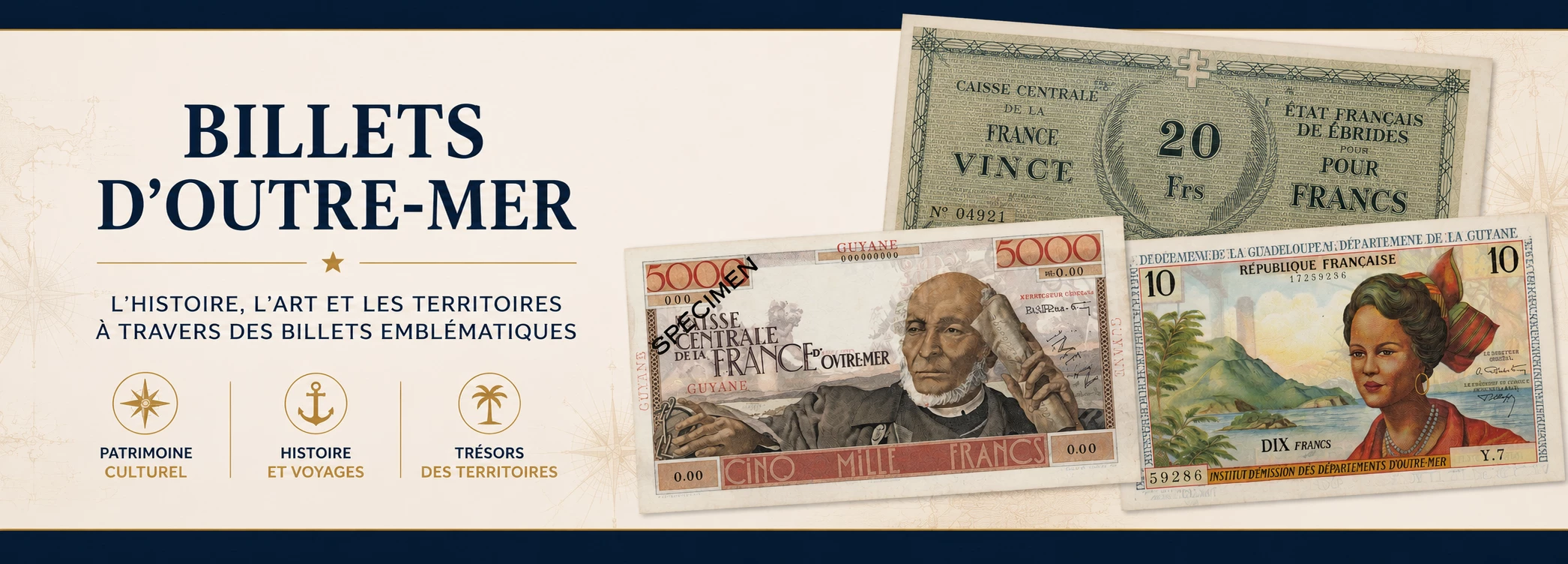
This type of banknote is associated with the Caisse Centrale de la France d'Outre-Mer (CCFOM), the institution responsible for monetary issuance in French overseas territories throughout the 20th century. Banknotes intended for Réunion during this period are generally distinguished by their illustrations evoking the landscapes, fauna and flora characteristic of the island, as well as symbolic representations of local and colonial life, typical of French overseas monetary iconography of the time.
The mention of the dual face value ? 5000 Francs and 100 Nouveaux Francs ? reflects the particular monetary context of Réunion at that time, when the franc reform led to a revaluation of banknotes through simple overprinting rather than immediate replacement. This process gives this banknote additional numismatic interest, bearing witness to an important economic and monetary transition in the history of the territory.