

 Français
 Espagnol
 Allemand
 Italien






Secure payment
3D secure

Delivery in 72 hours
Sending with tracking

Description
Remarks:
Plis, épinglages
Spécimen écrit à l'encre et Annulé par tampon
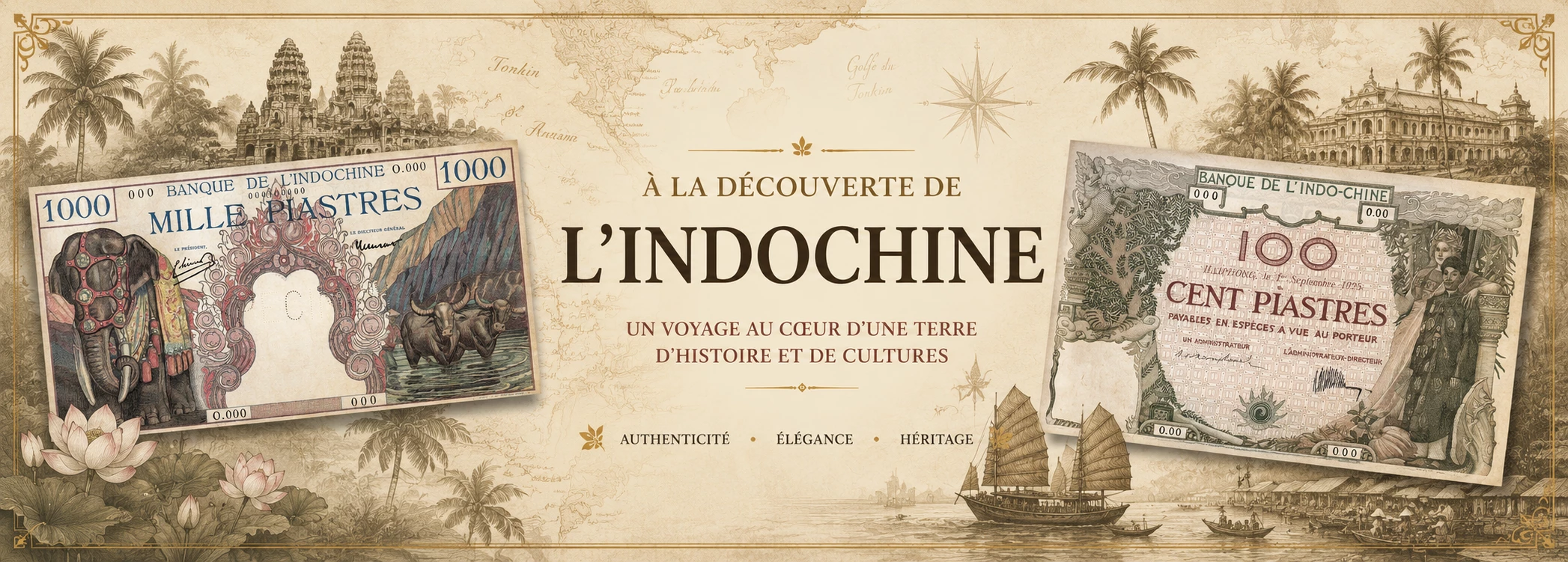
This 100 piastres banknote was issued in French Indochina during the period 1942-1945. It is a specimen, a particular category of banknote produced for reference or official presentation purposes, and not intended for regular circulation. These examples are generally perforated, stamped or overprinted with the word "SPECIMEN" to distinguish them from ordinary banknotes.
This banknote bears the letter P, which corresponds to a series or print series indication used to precisely identify the issuance batch to which it belongs. This letter plays an important role in the classification and authentication of banknotes from this period.
The central theme depicted on this banknote is that of a market, a scene illustrating the economic and daily life of French Indochina at the time. This type of iconography was frequently used by the Banque de l'Indochine, the issuing institution, to reflect local economic activities and the cultures of the territories under French administration, notably Vietnam, Laos and Cambodia.
The banknote belongs to a particularly sensitive historical period, marked by the Japanese occupation of Indochina during World War II. The Banque de l'Indochine nevertheless continued to issue banknotes under the control of the occupation authorities, which gives these issues an undeniable historical and documentary value.
As a specimen, this banknote is of particular interest to collectors and historians, as it bears witness to the issuance and monetary control practices in force at that time in French Indochina. Its state of preservation as well as its status as a specimen make it a reference numismatic document for the study of Indochinese numismatics of the mid-20th century.