Français
 Espagnol
 Allemand
 Italien


 Français
 Espagnol
 Allemand
 Italien






Secure payment
3D secure

Delivery in 72 hours
Sending with tracking

Description
Remarks:
Légères traces d'usure.
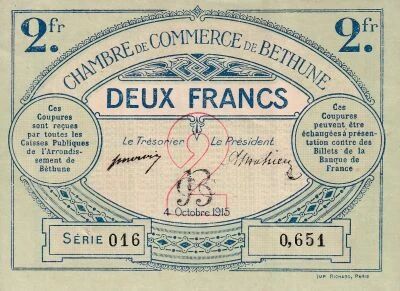
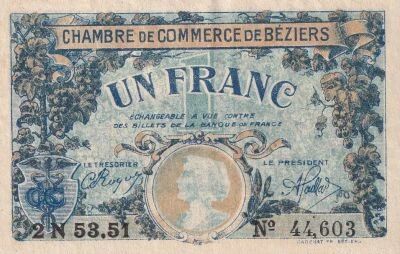
This 50 centimes note was issued by the Chambre de Commerce de Bayonne in 1915, in a context of monetary shortage characteristic of the First World War. During this period, many French chambers of commerce were forced to issue their own local fiduciary currency in order to compensate for the acute lack of metallic coins, whose materials were then largely requisitioned for the war effort.
The presented example bears the mention « Annulé » (Cancelled), indicating that it was officially withdrawn from circulation and invalidated by the issuing authority. This cancellation was a common procedure applied to notes at the end of their life or upon the withdrawal of an issue, generally materialised by a perforation, a stamp, or a handwritten or printed overprint on the document.
These local emergency issues, also known as emergency currencies or emergency notes, today constitute a fully recognised numismatic and notaphilic category, extensively documented in French specialised catalogues. The Chambre de Commerce de Bayonne, a city in the French Basque Country and an important regional economic centre, was among the many local institutions authorised to carry out such issues under state supervision.
The note has a face value of 50 centimes and was produced in France for strictly local use. Its weight is 1 gram, which is consistent with the lightness of the paper supports used for this type of low-denomination notes. These chamber of commerce notes from the 1914?1926 period are listed and valued in specialised reference works, notably the catalogue of French emergency notes.