

 Français





Secure payment
3D secure

Delivery in 72 hours
Sending with tracking

Description
Remarks:
2 coupures et déchirures et salissures
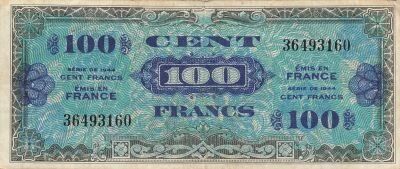
The 100 francs Descartes banknote is a paper money specimen issued in 1942 by France, during the height of the Occupation period. It belongs to series B.3, which allows for the precise identification of its manufacturing and circulation order within the production of this type.
This banknote takes its name from the French philosopher and mathematician René Descartes (1596-1650), whose effigy is depicted on the document. Descartes, a major figure in Western thought and author of the famous Discourse on the Method, was chosen to embody the intellectual prestige of France on this high-denomination banknote for the era. His representation is part of the French tradition of honouring great figures from literature, science and philosophy on fiduciary currency.
The banknote displays the graphic and typographic characteristics typical of the productions of the Banque de France during this particular historical period. Banknotes issued under the Vichy regime retained the institutional attributes of the Banque de France while being produced in an economic and political context profoundly disrupted by the Second World War.
From a technical standpoint, this banknote carries a face value of 100 francs. Banknotes of this type, issued in large quantities to meet the needs of the wartime economy, are today direct witnesses to the monetary and economic history of France in the early 1940s.
For collectors and numismatic historians, series B.3 serves as a reference element for establishing the chronology of the issue and differentiating individual specimens. The state of preservation of each banknote considerably influences its documentary and numismatic value.