

 Français
 Espagnol
 Allemand
 Italien







Secure payment
3D secure

Delivery in 72 hours
Sending with tracking

Description
This 100 francs banknote was issued for French Somaliland, a French colonial territory whose capital was Djibouti, during the period spanning from 1928 to 1938. This is a specimen example, a special status assigned to banknotes produced for reference or archival purposes, intended for banking institutions or administrations to enable the authentication of banknotes in circulation, and not for regular commercial use.
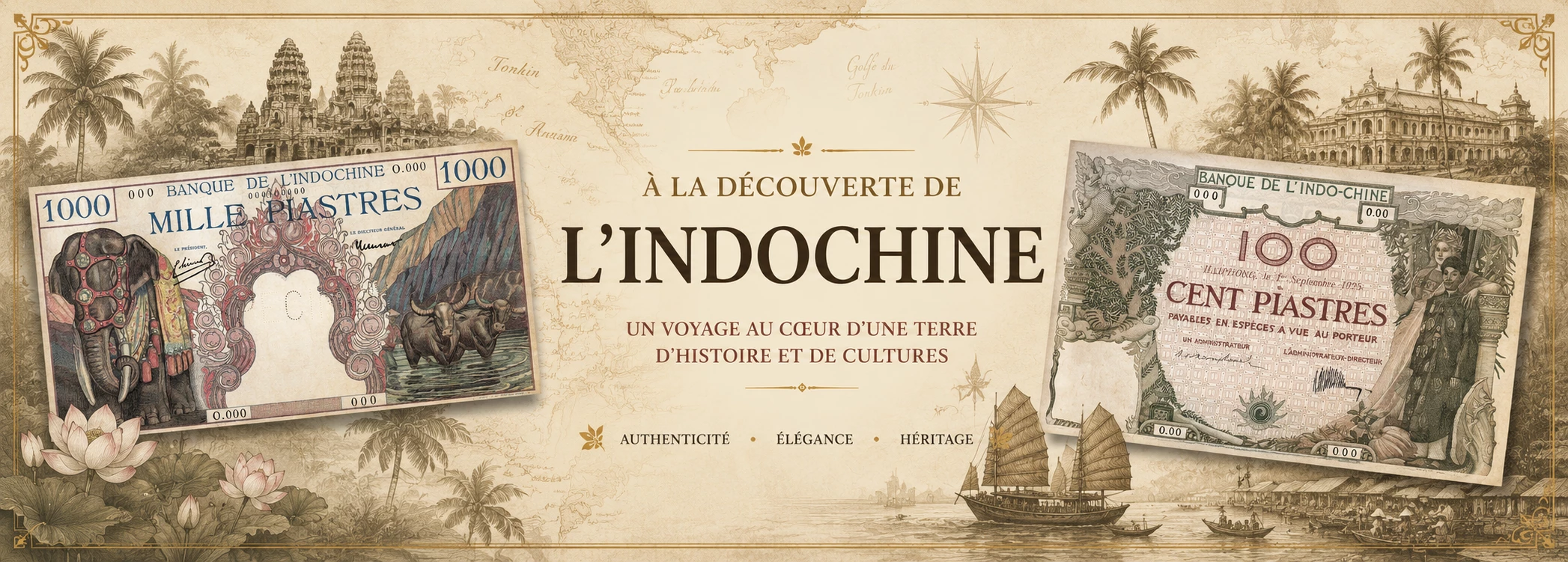
Specimen banknotes from this French colonial era represent important documentary testimonies of the region's monetary history. French Somaliland used the franc as its official monetary unit at the time, under the authority of French financial institutions overseeing monetary issuance in overseas territories. Banknotes issued for this territory were generally produced by the Banque de l'Indochine, which held the privilege of issuance in several French colonies during this period.
French colonial banknotes from the interwar period are typically characterised by evocative iconography of the represented territories, blending local motifs with symbols of the French presence. Specimens are distinguished from ordinary banknotes by the presence of perforations, overprints or specific inscriptions indicating their special status, in order to prevent any fraudulent use.
From a numismatic standpoint, specimen colonial banknotes from the interwar era are considered rare pieces, as their distribution was strictly limited to a restricted circle of official institutions. The issuance period of 1928-1938 covers a decade marked by major global economic upheavals, including the Great Depression, which gives these documents additional historical and documentary value for collectors specialising in French colonial paper money.